
Durability at Kona: is the marathon won or lost on the bike?

Anyone who has raced Kona knows the moment. You get off the bike on the Queen K and there's still a marathon to go, out to the Energy Lab and back. Which raises a question I keep coming back to: if you're already fading at the back end of the bike, are you automatically less durable on the run? To explore it, I analysed the race files of four athletes who raced Kona in 2026 (Athletes B to E), plus earlier Kona races where we had them.
My 2018 race: a rock steady bike
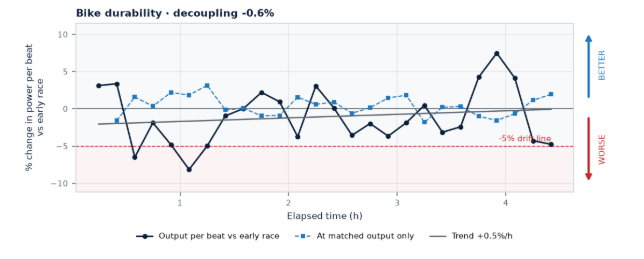
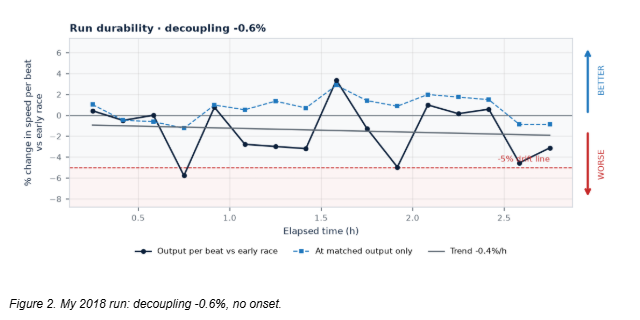
My own 2018 race shows what holding the back end of the bike can look like. My bike decoupling was -0.6%, with no drift onset at all, and 259 W normalised power (FTP then was 370 w, so a easy bike). My last quarter power was 6.6% higher than the first (242 to 258 W). Then came a 2:50:56 marathon, with -0.6% run decoupling. Race conditions are also undeniably playing a big part.
What is durability?
In 2021 we defined durability as the time of onset and magnitude of deterioration in physiological characteristics duri...
Carbohydrates During Exercise and Athlete Durability: Our Recent Publication

It’s not what you can do for 5 minutes, it’s what you can do for 5 minutes after five hours. As endurance athletes, we know that our endurance – our physiological and psychological ability to endure, to keep going as the hours tick up in our event – is fundamental to our performance.
‘Durability’ is an emerging concept in exercise physiology, and, more importantly, we think, a critical factor in endurance training and performance. In our 2021 paper, we defined durability as an athlete’s resilience to the effects of prolonged exercise on their physiological profiling characteristics – the thresholds we use to inform pacing strategies, programme training sessions, and monitor training load (1). Subsequently, durability has been proposed as a crucial factor in endurance performance, as it defines, physiologically at least, our ability to stave off the upward creep in effort required at a given speed or power output as exercise progresses (2). As readers of our blogs, or our monthly Train...
What Causes Muscle Cramping in Endurance Athletes?

Lots of athletes will know the feeling. It’s a bit like there’s a small knot forming beneath the skin, in your hamstrings or calves. The tension grows, and the muscle starts to contract involuntarily. The cramp usually begins as repeated twinges or flutter-like waves of contractions. It only builds from there, and shifts from discomfort to sharp, intense pain. You have to stop to stretch it out, which relieves the cramp momentarily, before it comes back, over-and-over again.
Cramp can be debilitating for some athletes, effectively ending races in a painful stop-start jerk to the finish. For lucky athletes, it never seems to happen at all. Exercise-induced cramps are, amazingly, still a bit of a mystery.
In this blog, we’ll discuss what we think might be going on with exercise-induced muscle cramping, and suggest some strategies that athletes might use to combat them.
What causes exercise-induced muscle cramping?
Like I said, the precise cause of exercise-induced muscle cramping is...