
Durability at Kona: is the marathon won or lost on the bike?
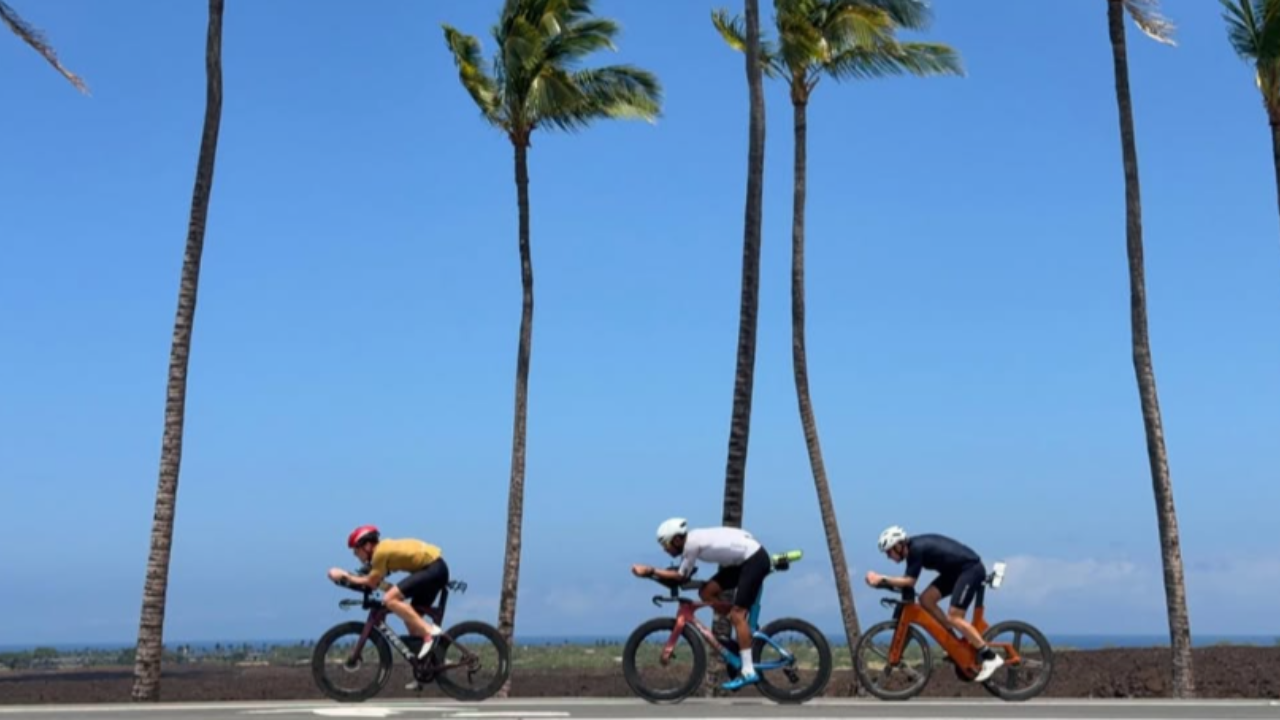
Anyone who has raced Kona knows the moment. You get off the bike on the Queen K and there's still a marathon to go, out to the Energy Lab and back. Which raises a question I keep coming back to: if you're already fading at the back end of the bike, are you automatically less durable on the run? To explore it, I analysed the race files of four athletes who raced Kona in 2026 (Athletes B to E), plus earlier Kona races where we had them.
My 2018 race: a rock steady bike
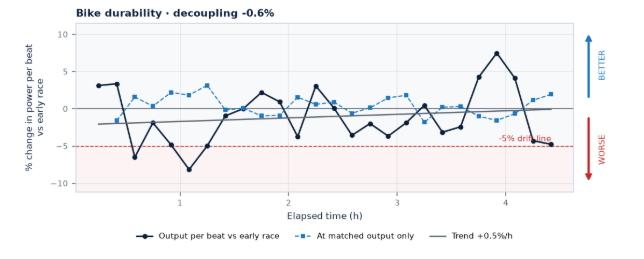
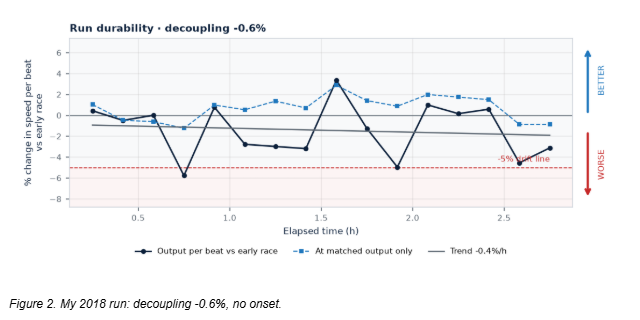
My own 2018 race shows what holding the back end of the bike can look like. My bike decoupling was -0.6%, with no drift onset at all, and 259 W normalised power (FTP then was 370 w, so a easy bike). My last quarter power was 6.6% higher than the first (242 to 258 W). Then came a 2:51:22 marathon, with -0.6% run decoupling. Race conditions are also undeniably playing a big part.
What is durability?
In 2021 we defined durability as the time of onset and magnitude of deterioration in physiological characteristics during prolonged exercise [1]. Put simply, it's how well you hold on to your fresh physiology when you're no longer fresh.
In the lab, power at the first ventilatory threshold (VT1) falls after 2 hours of cycling [2], the decline is non-linear [3], and those who lose the least also lose the least 5-min time trial power [4].
How I analysed the files
I split each race into bike and run and worked out output per heartbeat (watts per beat on the bike, speed per beat on the run), comparing the first half with the second. Under 3.5% drift is noise, 3.5 to 5% is mild, and over 5% is meaningful. I also flagged the "onset", where efficiency fell more than 5% below the early-race baseline and stayed there, and compared the four quarters of each leg.
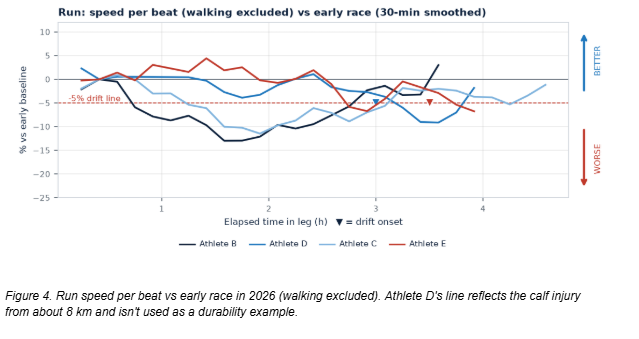
Two pieces of context. Athlete D pulled his calf about 8 km into the 2026 run, so that marathon reflects an injury, not durability, and I've left it out. And Athlete E was sick two days before the race.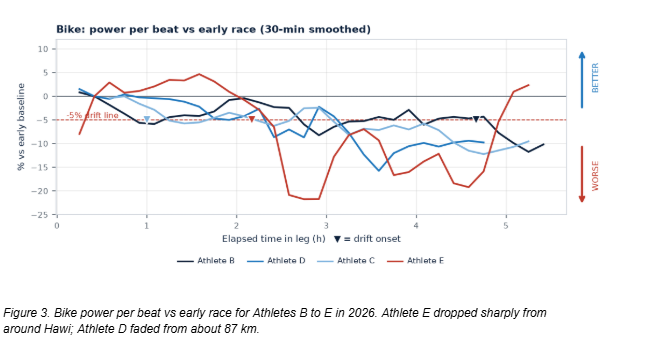
What the four athletes show
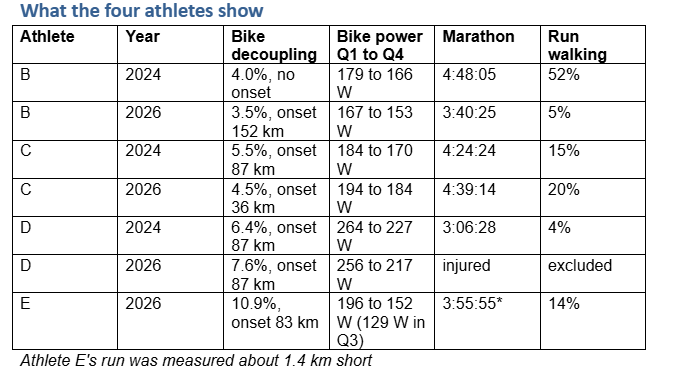
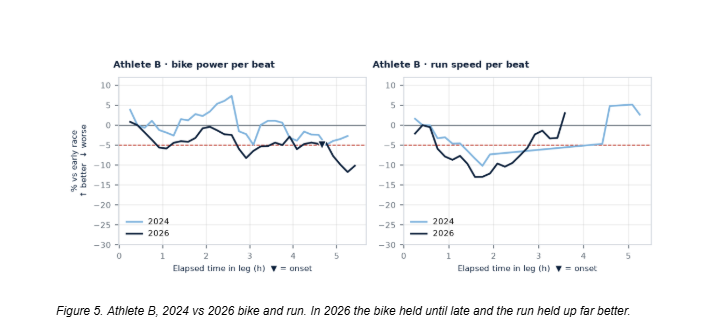
- Athlete B made the podium in 2026 and had easily the best race of the group this year, and it's the race that fits the idea best. The bike was steady (3.5% decoupling, with onset only at 152 km), and the run was steady too: -1.5% decoupling, 4.7% walking and a 3:40:25 marathon.
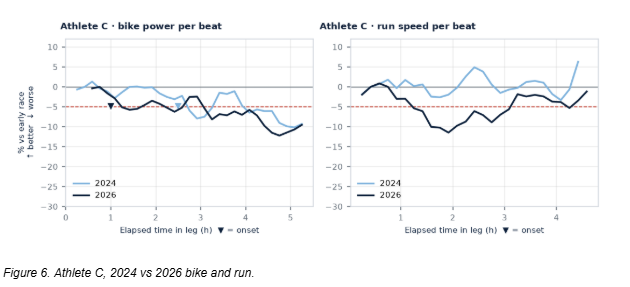
- Athlete C's bike was a touch steadier in 2026 (with some power data missing), but the run was about 15 minutes slower, with pace and heart rate falling together from 5:48 to 7:05/km.
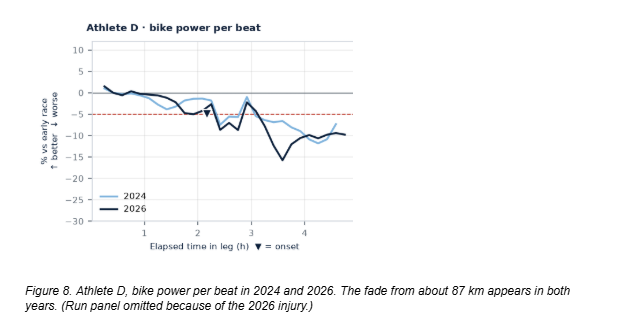
- Athlete D faded on the bike from about 87 km in both years, by 14 to 15% of power. Yet in 2024 he still ran 3:06 with 4% walking.
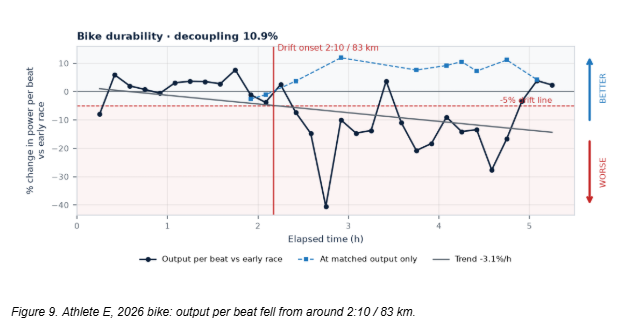
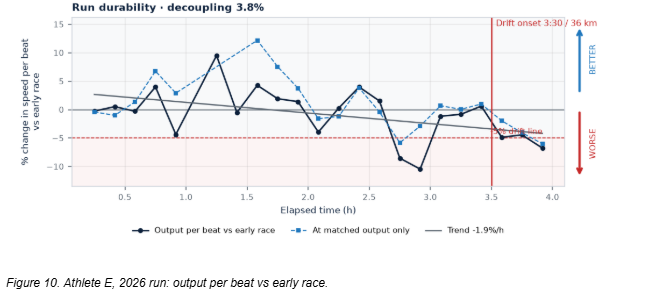
- Athlete E faded most on the bike, from around Hawi, with power and heart rate dropping together. His run quarters went 5:24, 7:23, 5:24 and 5:24/km, with heart rate dipping to 109 bpm in the second quarter and returning to 133 to 134 bpm. So the back half was stronger than the second quarter, but no faster than the first. Given he'd been sick, my hunch is he may have had to hold back through the middle and had a bit more left late on, though the file alone can't confirm it.
So, does a fading bike mean a fading run?
Athlete B in 2026, and my 2018 race, fit the idea: hold the back, or ride within yourself on the bike and the run holds too. But the other races don't settle it. Athlete D faded on the bike and still ran 3:06 in 2024? However, this same athlete is an excellent runner, and we did actually predict a faster marathon time. I would say that this run wasn't to his full potential. There is always nuance, so it's difficult to get to the bottom of with real-world data. However, at the same time, if you look at my data from 2018, there is undeniably zero fade and exceptional durability. It stands to reason that it is certainly a metric worth measuring in training.
So test it in your own racing. Compare your decoupling over the last part of the bike with how much your run fades in the second half, race to race.
Take-home points for training
-
Hold your bike durability. Pace the first half of the bike evenly rather than hard, fuel from the start, and practise quality work late in long rides. Whether it protects the run is still open, but it's unlikely to hurt.
-
Build fat oxidation. Gallo et al. found durability was related to fat oxidation rates at specific intensities, though not to peak fat oxidation [3]. Of course, that's a correlation, not proof, but plenty of steady aerobic volume seems a sensible bet.
-
Do quality work under fatigue. Our lab protocols put the hard efforts after 2 to 2.5 hours of riding [2,4]. Try a few intervals, or a steady run off the bike, late in long sessions.
-
Fuel to protect your thresholds. Carbohydrate during 150 minutes of cycling roughly halved the VT1 drop (3% vs 6%) [5]. Right Fuel, Right Time.
-
Monitor decoupling. Heart rate drift at a fixed power was the best practical marker of lost threshold power (r = -0.76) [6]. Track it in long sessions.
-
Test fresh and fatigued. A 5-min effort fresh, then again after a long ride [4], tells you more than either alone.
There aren't intervention studies on training durability yet, so I'm open to revising all of this.
EndureOn.
References
-
Maunder E, Seiler S, Mildenhall MJ, Kilding AE, Plews DJ. The importance of 'durability' in the physiological profiling of endurance athletes. Sports Med. 2021;51(8):1619-1628. doi:10.1007/s40279-021-01459-0
-
Stevenson JD, Kilding AE, Plews DJ, Maunder E. Prolonged cycling reduces power output at the moderate-to-heavy intensity transition. Eur J Appl Physiol. 2022;122(12):2673-2682. doi:10.1007/s00421-022-05036-9
-
Gallo G, Faelli EL, Ruggeri P, Filipas L, Codella R, Plews DJ, Maunder E. Power output at the moderate-to-heavy intensity transition decreases in a non-linear fashion during prolonged exercise. Eur J Appl Physiol. 2024;124(8):2353-2364. doi:10.1007/s00421-024-05440-3
-
Hamilton K, Kilding AE, Plews DJ, Mildenhall MJ, Waldron M, Charoensap T, Cox TH, Brick MJ, Leigh WB, Maunder E. Durability of the moderate-to-heavy-intensity transition is related to the effects of prolonged exercise on severe-intensity performance. Eur J Appl Physiol. 2024;124(8):2427-2438. doi:10.1007/s00421-024-05459-6
-
Dudley-Rode H, Zinn C, Plews DJ, Charoensap T, Maunder E. Carbohydrate ingestion during prolonged exercise blunts the reduction in power output at the moderate-to-heavy intensity transition. Eur J Appl Physiol. 2025;125(5):1349-1359. doi:10.1007/s00421-024-05687-w
-
Rothschild JA, Gallo G, Hamilton K, Stevenson JD, Dudley-Rode H, Charoensap T, Plews DJ, Kilding AE, Maunder E. Durability of the moderate-to-heavy intensity transition can be predicted using readily available markers of physiological decoupling. Eur J Appl Physiol. 2025;125(10):2911-2920. doi:10.1007/s00421-025-05815-0
JOIN THE SQUAD
Take charge of your performance with proven training programs and workouts, adjustable to your needs, in the Endure IQ Training Squad.
LIMITED OFFER